Friday, July 27, 2012

Gary's 74th Birthday

On the 74th anniversary of Gary Gygax' birthday I thought it fitting to post something about this. Wouldn't you know this was already done (probably better) over at gamesindustry.biz.  Tomas Rawlings looks at the legacy left by the designer of Dungeons and Dragons. Below is the article.

------------------------------------
"So how do I become a games designer?" is a question I often get asked as I engage with students and gamers in my work. The reply I often give is simple, "Shutdown your PC, switch off your tablet, turn your phone to silent then get hold of a copy of Dungeons & Dragons". Of course I don't mean the various video game versions (great as many of them are) and I don't mean the recent Facebook game (which is also fun). I mean the original rule book plus some pens, paper and loads of dice (don't forget those d20s!). Then, Level 1 Magic User, you will be ready to begin your journey...
Playing Dungeons & Dragons is one of the best ways to learn the foundations of game design. It is how I (and lots of others in the industry) learned about making games. By running Dungeons & Dragons games we had to master a number of key skills including narrative, drama, gameplay balancing and crucially, the all important stats systems. These diverse areas make Dungeons & Dragons a bit of a paradox; at once a geeky stats-fest and yet also the ultimate social game that only works with a group of friends. What makes it a great way to learn about game design also points to why all games developers owe its co-creator and gaming legend, Gary Gygax, a full horn of ale and a lot of thanks.
"I often feel that all we are doing with digital technology is trying to emulate the purity of gameplay that D&D achieved"
Sadly Gary is not with us today. He died back in 2008, aged 69. Gary was a gaming legend. As well as creating Dungeons & Dragons (along with Dave Arneson) then developing the concept into Advanced Dungeons & Dragons, he also founded the company TSR (now owned by Wizard of the Coast) and the Gen Con gaming convention as well as creating/assisting in a number of other game systems such as Chainmail (the forerunner of Dungeons & Dragons) and Lejendary Adventure.
But for me, his most important legacy is Dungeons & Dragons (aka D&D). If you've not played it, its a Role Playing Game (RPG), played by a bunch of friends sat around a table. One person runs the game (the Dungeon Master or DM for short) while the rest take the role of players within the DM's world. The game is moderated by the DM to a framework set by the D&D rule books and rendered in the player's imaginations. D&D is pure social gaming - it is all about the people playing. And D&D is pure multiplayer gaming - it is all about the player's joint interactions. I often feel that all we are doing with digital technology is trying to emulate the purity of gameplay that D&D achieved.
It is also the great-grandfather of much of video gaming. Why? D&D, the product of Gary's rich imagination was based on a key insight to merge character, narrative and stats into a 'game engine'. D&D envisioned a fictional world simulator designed to be played within (and with). This core idea is still the basic framework for so much of today's video games industry. For example D&D has Hit Points and Damage Modifiers, Hit Rolls and Armour Classes - how many other video games, even non-RPGs, have borrowed this combat framework? D&D has progression with character levels, equipment, skills, spells and more. How many games use the various incarnations of levelling up to keep players interested? Tens of thousands. D&D gave roles to the participants via character classes such as Fighter, Magic User, Cleric, Thief and more. How many games use this approach of allowing the player to map their identity into the game? The answer is legion.
When I first learned to code about aged 12 (BASIC on the BBC), the first program I wrote was a character generator for D&D that rolled up the basic stats for a new character; the two were a natural fit. The first collaborative game I worked on (aged around 13) was an attempt at a D&D type RPG with a fellow pupil who could code much better than me. D&D worked as a video game like dwarves work with beards and gold.
1
AD&D Dungeon Masters Guide, revised edition, 1979.

D&D was also the seed for much more. The basic world-building structure of D&D was a rich source of inspiration for other games and many other games followed from Gary's template; RuneQuest, Boot Hill, Stormbringer and Call of Cthulhu to name a few. They were always defined in relation to D&D; Call of Cthulhu was like D&D but with less emphasis on the combat and no levelling up. RuneQuest was like it but had a more expansive combat system, and so on.
I have a fairly sizeable collection of RPG games (I know, I know, it's a wonder that I'm not single, much less married. The secret is a Level 3 Charm Spell.) At home, on my book shelf with pride of place is the TSR 2nd edition of Dungeons & Dragons. For all the reasons I've outlined and the hundreds of hours I spent playing the game, I'd like to raise a mug of mead to Gary Gygax; innovator, game designer, geek, star of Futurama and somebody who brought gaming to the millions. Short of eradicating malaria or something like that, it is hard to imagine a better legacy to leave to the world; that being the bringer of such a volume of fun.

Wednesday, July 11, 2012

City of Greyhawk Map - Undercity

While the current Greyhawk campaign is on hiatus I still am working on certain aspects of that campaign. Since I have always loved maps of all sorts and in all forms I have been continuing my City of Greyhawk maps. While there are still many improvements to be made here is a work in progress on my current undercity map of Greyhawk.


City of Greyhawk - undercity
The above ground City of Greyhawk article  that I posted previously.

Wednesday, July 4, 2012

July 4th

Some inspiring words to remember on this day.


Declaration of the thirteen United States of America 


When in the course of human events it becomes necessary for one people to dissolve the political bands which have connected them with another and to assume among the powers of the earth, the separate and equal station to which the Laws of Nature and of Nature's God entitle them, a decent respect to the opinions of mankind requires that they should declare the causes which impel them to the separation.

We hold these truths to be self-evident, that all men are created equal, that they are endowed by their Creator with certain unalienable Rights, that among these are Life, Liberty and the pursuit of Happiness. — That to secure these rights, Governments are instituted among Men, deriving their just powers from the consent of the governed, — That whenever any Form of Government becomes destructive of these ends, it is the Right of the People to alter or to abolish it, and to institute new Government, laying its foundation on such principles and organizing its powers in such form, as to them shall seem most likely to effect their Safety and Happiness. Prudence, indeed, will dictate that Governments long established should not be changed for light and transient causes; and accordingly all experience hath shewn that mankind are more disposed to suffer, while evils are sufferable than to right themselves by abolishing the forms to which they are accustomed. But when a long train of abuses and usurpations, pursuing invariably the same Object evinces a design to reduce them under absolute Despotism, it is their right, it is their duty, to throw off such Government, and to provide new Guards for their future security...

Wednesday, April 18, 2012

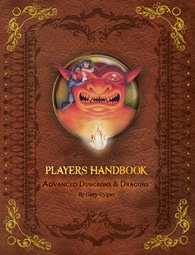
1st Edition AD&D Reprints to be available outside North America

Good news for those outside North America who were hoping to get their hands on one of the upcoming 1st Edition AD&D deluxe reprints.

The product description on WotC's site has been changed - it no longer says North American hobby retail channels only.

In addition, the books have popped up on both


You can read about the reprints here, and see the new book covers here. Some of the profit from these books goes to the Gygax Memorial Fund.

Tuesday, April 3, 2012

WotC play April Fools


Wizards April Fool's article for Dungeon magazine. I really didn't find much of it funny.


Greyhawk 2023 Mini-Campaign
By John Rossomangno
Imagine the world of Greyhawk in the distant future, where the clones of Bigby, Melf, and other legendary heroes wage war against tyrannical dragon-cyborgs, Far Realm invaders, and other threats. This mini-campaign gives you everything you need to get your new campaign started!

Mordenkainen’s Futuristic Adventure
By Bruce R. Cordell
The city of Greyhawk is a smoldering crater, but all is not lost! In the dungeons below the ruins of Castle Greyhawk, Mordenkainen’s clone has discovered a portal to a “lost level” and clues to a time-travel machine built by the archmage Zagyg. A D&D adventure for characters of levels 10–14.

Module V1
By Tracy Hickman
A year ago, a small group of Wizards employees visited the old TSR warehouse in Lake Geneva. Amid the boxes of old files and contracts, they found an unpublished adventure manuscript by Tracy Hickman combining the tropes of Vikings and Norse mythology with old-school tomb exploration. An AD&D 2nd Edition adventure for characters of levels 8–10.

Last Voyage of the Princess Ark
By Robert J. Schwalb
The Princess Ark, a legendary flying ship, has crashed! Explore the wreckage to find out what happened, and loot the bodies of the dead. A D&D adventure set in the world of Mystara for characters of levels 1–3.

Unearthed Arcana: The Truth Is Out There
By Randall Walker
Aliens abducted your star-pact warlock, which explains the alien probe he wields as a rod. You thought the Far Realm was scary before? Here’s a version inspired by The X-Files.

The Ecology of the Vegepygmy
By Téos Abadia
What’s short, mean, and tastes like the lettuce-wrapped meat at P.F. Chang’s?

D&D Alumni: Owlbears are Dumb, Or Are They?
By Chris Youngs & Bart Carroll
Chris Youngs explains why owlbears are dumb and why they shouldn’t be allowed in the next iteration of the D&D game. Bart tells Chris he’s a boob. Decide the owlbear’s ultimate fate in a special D&D poll.

 Maybe I'm just taking it the wrong way, but if they're trying to win any points with the old schoolers this ain't it. Its seems to be trying to be self deprecating but it just comes across as mocking TSR and earlier versions of D&D, in my opinion.

Sunday, April 1, 2012

What Kind of D&D Character Would You Be?

While not strictly AD&D 1ed this test (while long) came up with rather amusing  results. I must admit I usually do play Fighters or Magic Users but tend to stray more towards the choatic end of the spectrum in game, mostly because of the group dynamic and the way we interact during game play. While I tried not to fudge on my answers, it's much easier to give the "right" answer on a quiz than during real life interactions. So, as with anything on the net "take with a grain of salt."


-------------------------verbatim results-----------------------------
(Take the quiz here.)

This is what it came up with for me:

I Am A: Lawful Good Human Paladin/Sorcerer (4th/3rd Level)
Ability Scores:
Strength-18
Dexterity-17
Constitution-17
Intelligence-16
Wisdom-15
Charisma-14

Alignment:
Lawful Good A lawful good character acts as a good person is expected or required to act. He combines a commitment to oppose evil with the discipline to fight relentlessly. He tells the truth, keeps his word, helps those in need, and speaks out against injustice. A lawful good character hates to see the guilty go unpunished. Lawful good is the best alignment you can be because it combines honor and compassion. However, lawful good can be a dangerous alignment when it restricts freedom and criminalizes self-interest.

Race:
Humans are the most adaptable of the common races. Short generations and a penchant for migration and conquest have made them physically diverse as well. Humans are often unorthodox in their dress, sporting unusual hairstyles, fanciful clothes, tattoos, and the like.

Primary Class:
Paladins take their adventures seriously, and even a mundane mission is, in the heart of the paladin, a personal test an opportunity to demonstrate bravery, to learn tactics, and to find ways to do good. Divine power protects these warriors of virtue, warding off harm, protecting from disease, healing, and guarding against fear. The paladin can also direct this power to help others, healing wounds or curing diseases, and also use it to destroy evil. Experienced paladins can smite evil foes and turn away undead. A paladin's Wisdom score should be high, as this determines the maximum spell level that they can cast. Many of the paladin's special abilities also benefit from a high Charisma score.

Secondary Class:
Sorcerers are arcane spellcasters who manipulate magic energy with imagination and talent rather than studious discipline. They have no books, no mentors, no theories just raw power that they direct at will. Sorcerers know fewer spells than wizards do and acquire them more slowly, but they can cast individual spells more often and have no need to prepare their incantations ahead of time. Also unlike wizards, sorcerers cannot specialize in a school of magic. Since sorcerers gain their powers without undergoing the years of rigorous study that wizards go through, they have more time to learn fighting skills and are proficient with simple weapons. Charisma is very important for sorcerers; the higher their value in this ability, the higher the spell level they can cast.

Find out What Kind of Dungeons and Dragons Character Would You Be?, courtesy of Easydamus (e-mail)