Say what you will about the man, his stories were inspired/inspiring. Probably this intro by Asimov from Dangerous Visions best encapsulates some of the salient points about Ellison, besides its kinda funny.

Mostly AD&D 1st edition based in the World of Greyhawk and other stuff that strikes my fancy
 |
| Source. |
 |
| via TOR.com |


 For those who might not have heard about it in their newsfeeds yet, there is a 8 book megabundle sale on the AD&D Core Book PDF's. Currently only $14.95 vs the usual $75.


 |
| Click here for larger image |
 |
| Click here to see a larger version of the map. |
Ulysses led the brave Cephallenians, who held Ithaca, Neritum with its forests, Crocylea, rugged Aegilips, Samos and Zacynthus, with the mainland also that was over against the islands.“Huh,” you say, “Okay, Homer, I’ll take your word for it.” Questions of historicity aside, we can at least say that the hundreds of cities and towns mentioned in this culturally formative text did exist, or continue to do so, though it’s debatable, as Jason Kottke writes, whether “that level of mobility was accurate for the time [somewhere in the 11th or 12th century BC] or if Homer simply populated his poem with folks from all over Greece as a way of making listeners from many areas feel connected to the story.”
Thoas, son of Andraemon, commanded the Aetolians, who dwelt in Pleuron, Olenus, Pylene, Chalcis by the sea, and rocky Calydon,
And those that held Pherae by the Boebean lake, with Boebe, Glaphyrae, and the populous city of Iolcus

 Just like I did the other week, I just got an email about the new updated Dungeon Master's Guide PDF.
 The 1st Edition Player's Handbook is back!
David A. Trampier, the Illustrator Who Defined the Look of Advanced Dungeons & Dragons, Has Passed Away, 1954-2014
The Southern Illinoisian, the regional paper for Carbondale, Illinois, has listed an obituary for David A. Trampier, the artist responsible for defining the look of Advanced Dungeons & Dragons, from the first edition and onwards.
Trampier was doggedly reserved throughout his life, to such an extent that most D&D fans know his work more than they know his name. He disappeared in 1988, leaving his ongoing comic D&D Wormy abruptly unfinished, and retired from illustration to drive a Yellow Taxi in Carbdondale, Illinois. (The above photo from 2003 is one of the only pictures ever snapped of Trampier.)
According to the Castle Perilous Games & Books store blog, Trampier suffered a stroke late last year but was considering convention appearances and some illustration work in the future. You can read further details in their recollection and see more about his work here.
Thank you, David Trampier for bringing character and life to a gaming series that means so much to so many.
Take a look at Trampier's iconic illustrations below:

 |
The Raven (1963) |
In this tongue-in-cheek movie inspired by Poe's poem, Dr. Craven is the son of a great sorcerer (now dead) who was once himself quite skilled at that profession, but has since abandoned it. One evening, a cowardly fool of a magician named Bedlo comes to Craven for help- the evil Scarabus has turned him into a raven and he needs someone to change him back. He also tells the reluctant wizard that Craven's long-lost wife Lenore, whom he loved greatly and thought dead, is living with the despised Scarabus.
John Ronald Reuel Tolkien (1892-1973) didn’t live long enough to witness modern video games, or play Dungeons & Dragons, or even to see his works turned into movies. But as The Hobbit proved popular, and Lord of the Rings (published in 1954 and 1955) later became underground hits in the 1960s, it was clear his vision of Middle-earth had struck a chord. “Frodo Lives” and “Gandalf for President” slogans began to appear on bumper stickers, T-shirts, and buttons. Fan clubs sprang up. As readers began writing him, pestering him for details, noting discrepancies in his universe, and wondering when he’d write the next installment, he began to see how fans could get sucked into his world.
While Tolkien was said to be secretly pleased by how devoted his audience had become, the attention also made him uneasy. He named his readership “my deplorable cultus.” He knew fantasy could be dangerous — a “vast game,” he once wrote to his publisher about his writings, which could be “fatally attractive.” Even to himself.
The reclusive British scholar, lexicographer, and Oxford don was, in a way, the original geek. He specialized in the rather mundane field of philology (the history of languages). Most authors of the early twentieth century were busy smashing Victorian conventions and reassembling the pieces into irony-laden Modernism.
Not Tolkien.
An amateur writer, he didn’t even read contemporary fiction. He eschewed the modern world. He had founded literary clubs with archaic names: the TCBS (Tea Club and Barrovian Society), the Kolbitars society (so named because they sat so close to the fire they virtually bit the coals), and the Inklings. C. S. Lewis, author of the Narnia series, was also an Inklings member. Tolkien hung out with these fellow egghead, Middle Ages-minded pals in pubs, where they drank ale, smoked pipes, and made up stories by firelight.
To Tolkien the medievalist, Icelandic sagas and thousand-year-old poems like Beowulf were the finest literature ever written. Domineering dragons and world-weary wizards seemed perfectly legitimate characters for twentieth-century fiction. That’s why The Hobbit made sense. And why it worked. Tolkien wasn’t bowing to literary fashion, he was geeking out on his own passion. He didn’t worry whether his novels were seen as high art or bedtime story; in fact, he was doubtful his creations would have any appeal beyond his children and Oxford colleagues like C. S. “Jack” Lewis. Surrounded by those who didn’t get it, Tolkien was ridiculed. “How is your hobbit?” his colleagues mocked. Despite peer pressure, Tolkien remained undaunted.The Hobbit was published 75 years ago today, on September 21, 1937.
The Professor felt compelled to invent legends because, he believed, Britain lacked its own, true, homegrown mythology. With The Hobbit and Rings, all Tolkien wanted, he once said, was to “open the door on Other Time” and “stand . . . outside time itself.” He succeeded.
Because the fantasy genre is well established today, and so lucrative for entertainment, we forget there was a time when the heroic fantasy was not pop culture’s go-to genre.
In retrospect, what Tolkien accomplished seemed minor. One book. But he was a trailblazer. He wrote fantasy when few others did. Most of his stories were epic in length and told in a lofty language. (The Hobbit was one of his few works not aimed for an adult audience.) Their plots unfolded over a span of many years and often put ordinary characters — like Bilbo and Frodo — in extraordinary circumstances that involved magic, battles, strange creatures, and evil forces. Their quests restored some primal balance to the world.
Of course, with The Hobbit, Tolkien did not invent the genre. But, reviving its rules for the 20th century, he hit the literary jackpot. Right author, right time. No one could have predicted how well his heroic, romantic, high fantasy would catch on.
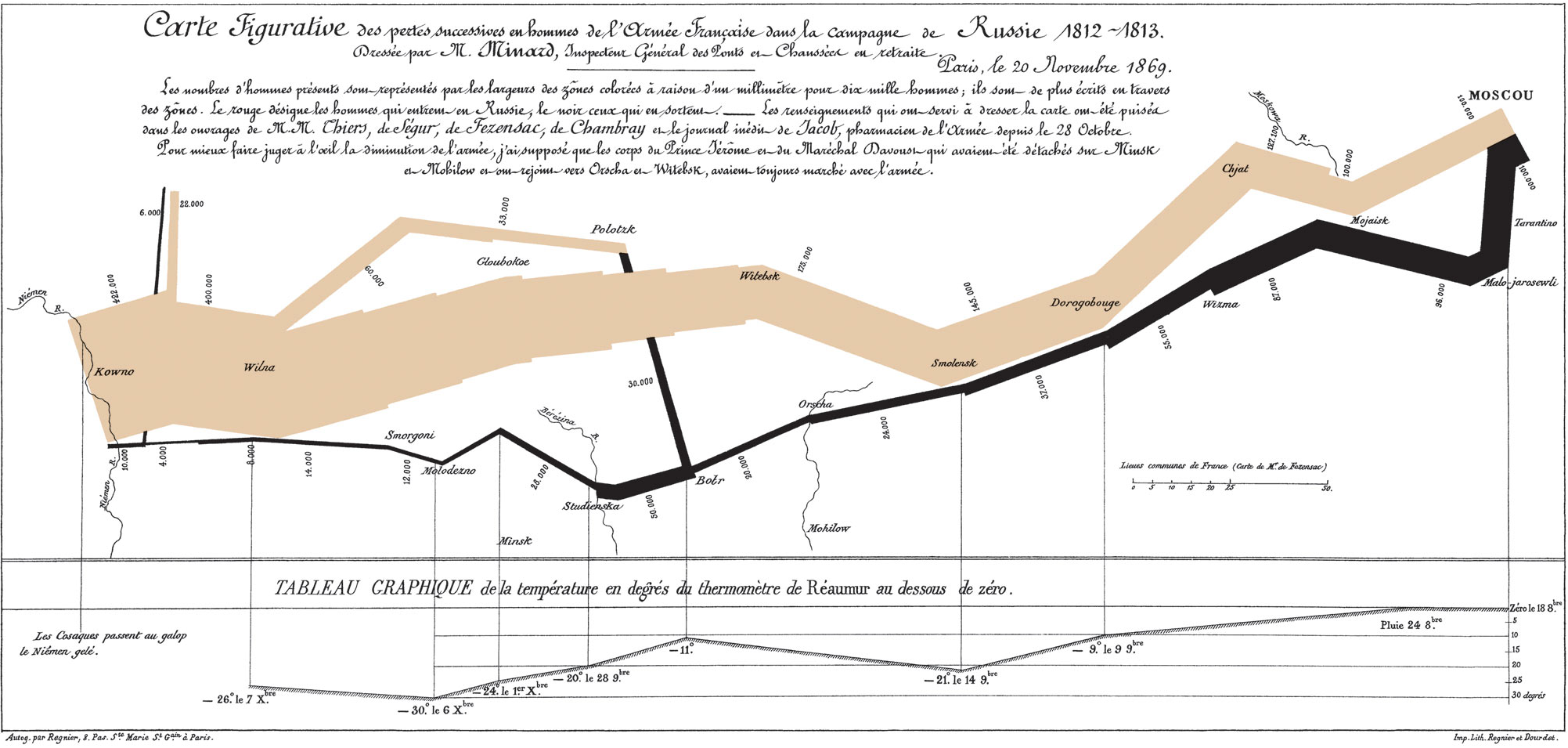
Napoleon’s Invasion of Russia
Published April 30, 2008 Charles Joseph Minard , History , War & Security 50 Comments
Napoleon Bonaparte began his ill-fated 1812 invasion of the Russian Empire with 422,000 men. With each step further into Russian territory, more and more soldiers died or deserted. By the time it reached Moscow, Napoleon’s army had dwindled to 100,000 men–already less than a quarter the size it had been at the start. During their disastrous retreat out of Russia, temperatures plunged to −37.5 °C. Nearly half the remaining survivors of the invasion were killed during the botched crossing of the Berezina River. Of the 422,000 men who set out on the invasion, barely 10,000 of them returned alive.
All this information is readily visible in the chart above, created by the French civil engineer Charles Joseph Minard, which ingeniously combined both a map of the campaign and a visual representation of the number of men remaining in Napoleon’s doomed army. The thickness of the line is proportional to the number of men in the army (one millimeter equalling 10,000 men), with the beige section representing the offensive toward Moscow, and the black line the retreat. Below, Minard also included a second chart showing the temperature on various days during the retreat (Minard used the Réaumur scale for his temperatures, as was commonplace at the time. Converted to Celsius, this makes the coldest part of the retreat a whopping −37.5 °C). For a large view of the chart, click on the picture above.
Although Minard includes a description above his chart, it is almost completely unnecessary; all the pertinent information is readily apparent from a close examination of the chart itself. Minard was a master at the production of maps such as these that combined tremendous amounts of data with geographic representations. Edward Tufte, an expert in the visual display of quantitative information, has called this chart “probably the best statistical graphic ever drawn.” More of Minard’s works will undoubtedly be featured here in time.
It’s also important to note why, on a blog about maps, the first post is in actuality more of a chart. Although the most striking feature of the chart is the thinning line of soldiers, the map in the background plays an important role, showing the cities and rivers the army traversed on its way into and out of Russia. This chart demonstrates how, with good planning a design, maps can operate in concert with many other types of information to create stunning displays of information.
I've been getting back into some Appendix N type reading lately and wanted to do a purely useful post for anyone who wants to get into "Appendix N" fantasy. I found this list tremendously useful when I was in high school as it pointed me to a lot of great stories that I still love.
Entries where volumes are in (parentheses) are individual books I've added to general names and/or series titles. Where possible I've pointed to in-print books and collections.
I claim no responsibility for any shopping binges you may go on after reading this post.
Anderson, Poul: THREE HEARTS AND THREE LIONS; THE HIGH CRUSADE; THE BROKEN SWORD
Bellairs, John: THE FACE IN THE FROST
Brackett, Leigh (The Sword of Rhiannon, The Ginger Star, The Hounds of Skaith, The Reavers of Skaith)
Brown, Frederic (Martians, Go Home, What Mad Universe)
Burroughs, Edgar Rice: "Pellucidar" series (At the Earth's Core, Pellucidar, Tanar of Pellucidar, Tarzan at the Earth's Core, Back to the Stone Age, Land of Terror, Savage Pellucidar); Mars series (Princess/Gods/Warlord of Mars, Thuvia/Chessmen/Master Mind/Fighting Man of Mars, Swords/Synthetic Men of Mars, Llana of Gathol, John Carter of Mars, Skeleton Men of Jupiter); Venus series (Pirates of Venus, Lost on Venus, Carson of Venus, Escape on Venus, The Wizard of Venus)
Carter, Lin: "World's End" series (The Warrior of World's End, The Enchantress of World's End, The Immortal of World's End, The Barbarian of World's End, The Pirate of World's End, Giant of World's End)
de Camp, L. Sprague: LEST DARKNESS FALL; THE FALLIBLE FIEND; et al
de Camp & Pratt: "Harold Shea" series; THE CARNELIAN CUBE
Derleth, August (The Cthulhu Mythos)
Dunsany, Lord (In the Land of Time And Other Fantasy Tales (includes Gods of Pegana), The King of Elfland's Daughter)
Farmer, P. J.: "The World of the Tiers" series (Volume 1, Volume 2); et al
Fox, Gardner: "Kothar" series (Kothar, Barbarian Swordsman, Kothar of the Magic Sword, Kothar and the Demon Queen, Kothar and the Conjurer's Curse, Kothar and the Wizard Slayer); "Kyrik" series (Kyrik: Warlock Warrior, Kyrik Fights the Demon World, Kyrik and the Wizard's Sword, Kyrik and the Lost Queen) ; et al
Howard, R. E.: "Conan" series (The Coming of Conan the Cimmerian, The Bloody Crown of Conan, The Conquering Sword of Conan) (Gygax neglected it, but Del Rey has his other work - The Savage Tales of Solomon Kane, Kull Exile of Atlantis, Bran Mak Morn: the Last King, El Borak and Other Desert Adventures, Sword Woman and Other Historical Adventures, The Horror Stories of Robert E. Howard)
Lanier, Sterling: HIERO'S JOURNEY (The Unforsaken Hiero)
Leiber, Fritz: "Fafhrd & Gray Mouser" series (Swords and Deviltry, Swords Against Death, Swords in the Mist, Swords Against Wizardry, The Swords of Lankhmar, Swords and Ice Magic, The Knight and Knave of Swords); et al
Lovecraft, H. P. (The Dreams in the Witch House and Other Weird Stories, The Thing on the Doorstep and Other Weird Stories, The Call of Cthulhu and Other Weird Stories - these are the Penguin editions with S.T. Joshi's introductions and notes; they are complete and superior versions to the scattered Del Rey books.)
Merritt, A.: CREEP, SHADOW, CREEP; MOON POOL; DWELLERS IN THE MIRAGE; et al (The Ship of Ishtar)
Moorcock, Michael: STORMBRINGER; STEALER OF SOULS (link is to recent Del Rey compilation of the original stires; also To Rescue Tanelorn, The Sleeping Sorceress, Duke Elric, Swords and Roses); "Hawkmoon" series (esp. the first three books) (The Jewel in the Skull, The Mad God's Amulet, The Sword of the Dawn, The Runestaff)
Norton, Andre (Witch World and many others)
Offutt, Andrew J.: editor of SWORDS AGAINST DARKNESS III
Pratt, Fletcher: BLUE STAR; et al
Saberhagen, Fred: CHANGELING EARTH; et al (Book of Swords)
St. Clair, Margaret: THE SHADOW PEOPLE; SIGN OF THE LABRYS
Tolkien, J. R. R.: THE HOBBIT; "Ring trilogy" (The Fellowship of the Ring, The Two Towers, The Return of the King) (also The Silmarillion)
Vance, Jack: THE EYES OF THE OVERWORLD; THE DYING EARTH; et al (Tales of the Dying Earth omnibus)
Weinbaum, Stanley (The Black Flame, The Lotus Eaters, A Martian Odyssey)
Wellman, Manley Wade (Who Fears the Devil?, Battle in the Dawn)
Williamson, Jack (Darker Than You Think, The Humanoids)
Zelazny, Roger: JACK OF SHADOWS; "Amber" series (The Great Book of Amber); et al (The Lord of Light, Creatures of Light and Darkness)
 Dungeons of Dread is the reprint of the classic S series modules
(S1 - S4). This is a nicely put together package of some killer
modules, that I never had the good luck of actually playing all the way through.
Dungeons of Dread is the reprint of the classic S series modules
(S1 - S4). This is a nicely put together package of some killer
modules, that I never had the good luck of actually playing all the way through.
The Baen Free Library features some full-length novels from recent top authors, that are free to download. Well worth your time to check 'em out.Bayeux Tapestry - Fantasy
The full Bayeux Tapestry consisting of 35 parts. A full Latin to English translation is included. Also includes a selection of layman commentaries, highlights of various sections, and a section relating to the construction and history of the Bayeux Tapestry. There is also a link to the more important events that recount the story of the Battle of Hastings 1066.
Drawings from a residential designer, an architect, an artist, and an illustrator. A wide variety of drawings and watercolors here, some of them historical subjects, some of them original designs. Lots of inspiration.
Generators are divided into rough categories based on what they come up with. Some of them, such as the drink and name generators, are simple, whereas others, such as the civilization and pantheon gens, are much more detailed. If you want a generator that you can't find here, you can make your own with the custom gen builder.
Various re-enactment groups. From Classical Roman, Vikings on through the Dark ages all the way up to the Modern Era. Articles on early various technology, crafts, and photo galleries.Dave's Mapper - Online Mapper
Dave's Mapper is an online tool that allows GMs/DMs to generate random maps from a variety of map tiles created by artists in the gaming community.
- Free online mapping software.
- No downloads, installation or registration required.
- Simple interface
- Vast selection of objects and textures
- Layers and groups
- Export to png and jpg
- Maps sharing through online gallery
- Export to multipage pdf for print
- Special black & white collection for print
- Tile categories & subcategories with preview
- Square and hex grid
- Hotkeys
Encyclopedia of Fantasy - online EncyclopediaGenerators are divided into rough categories based on what game they apply to. From games of Fantasy to Science Fiction it has most of the popular ones covered.
The entire text of John Clute's 1997 work is a part of the beta text of the third edition of Clute's Encyclopedia of Science Fiction. While both books are technically aimed at academic users, they still make for good reading.Encyclopedia of Science Fiction - online Encyclopedia
The third edition of Clute's Encyclopedia of Science Fiction. While technically aimed at academic users, it still makes for good reading.Ex Astris Scientia Starship Gallery - Science Fiction
Various photos, schematics, renderings and screen captures of Federation and alien vessels, including many seldom "Alien-of-the-Week" ships. With very few exception most of the images are from "official" sources or based on the CGI models.
HeroMachine is a Flash-based web applet that allows you to dynamically create a customized character portrait.
A vast assortment of science and science fiction related info for anyone looking to build an extraterrestrial settlement. Covers various aspects such as engineering, funding, earth based examples, and political structures. Good background for SF games.
An alphabetical listing of slang words used in the "Jazz Age" (1920's). The twenties were the first decade to emphasize youth culture over the older generations, and the flapper sub-culture had a tremendous influence on main stream America; many new words and phrases were coined by these liberated women. These are the most common words and phrases of the time, many of which we still use today!
Mad Irishman Productions specializes in quality role-playing products, particularly character sheets for your favorite games. Here you will find many free goodies in Adobe PDF format and the occasional PDF Form which you can fill out directly.
Represents a small fraction of the 4.5 million items in the Library of Congress - Geography and Map Division that have been converted to digital form.The focus of Map Collections is Americana and Cartographic Treasures of the Library of Congress. These images were created from maps and atlases and, in general, are restricted to items that are not covered by copyright protection.
An online magazine made for Ogres, Goblins, Hobgoblins, Gremlins, Ridgelings and all other manner of green-skinned Orcs!
An inspired collection of Orc-themed magazine spoofs.Pawn - Fantasy
Pawn is a whimsical fantasy erotic comic that contains as much nudity as it does humour, therefore it's best suited for equally silly adults. If you are new to it start at part 1.Renaissance and Fantasy Fonts - Fonts
A collection of renaissance, historic, and fantasy TrueType fonts (text, runic, and symbols). Useful for maps, handouts, character sheets, and whatever else you can possibly think of.
The main part of this site is a database of historical sailing vessels, with technical data as well as "biographical" information on individual vessels. The aim is to have a comprehensive listing of 19th and 20th century square riggers.
The Super Friends somehow stayed alive for 10 years by hiring people who could talk to fish, match a cape to their underwear, and turn into a bucket of water. They fought everyone from supervillains to dolls from space to insane altruists who decided that making giant unstoppable mutant fish and running the Earth into a comet was the best way to solve our "food shortage."
This site is to help you relive insane cartoon memories, see Green Lantern's preteen pal, or learn how to incorporate the Super Friends into your binge drinking.
A variety of image galleries featuring stars from the silent film era. Useful for character illustrations.
This site gives visual comparisons of the true scale of your favourite science fiction spacecraft. It compares ships across genres, as well as comparing them with contemporary objects with which you are familiar.
Starship Schematics is dedicated to the sole purpose of archiving every single starship design ever conceived in the Star Trek, Battlestar Galactica, Babylon 5, and Space Battleship Yamato (a.k.a. Star Blazers) Universes, both official and unofficial, interesting and mediocre.
A website for use with the Star Wars® Roleplaying Game by West End Games®, within you will find deckplans and schematics of space transports and vehicles for use as player handouts, and/or Gamemaster reference. Created by fans for the fans of the Original Star Wars® Trilogy, the players of the D6 roleplaying game, and fans of the Star Wars® Expanded Universe.
The Star Wars Artists' Guild (SWAG) exists to promote the development and unity of artists in the Star Wars Roleplaying Game community. In pursuit of this, SWAG provides a venue where SWRPG artists can exhibit their work, thereby helping create a library of high quality SWRPG art available to all members of the community for use in their own roleplaying games. In addition, SWAG also provides a means for members of the SWRPG community to contact various artists regarding specific requests for SWRPG-related art and similar exchanges.
Do you want your child to become an evil genius when he or she grows up? Perhaps you can prepare for this by giving the child the right name to begin with. Here is a list of names which mean dark, deadly, spooky or just have plain neat meanings.
The home of Thundarr the Barbarian on the web. Features news, images, various downloads, an episode guide, message board, and Awards. Ariel! Ookla! Riiiiide!
The 36 Plots is an interpretation of The Thirty-Six Dramatic Situations by French writer George Polti. The original work analyzed classic Greek literature, classic and contemporary French literature, and a handful of non-French texts as an extension of Carlo Gozzi's work from the mid-1700's in order to categorize every dramatic situation that could happen within literature. This article applies the concept to RPG games, though in my mind, any good fantasy story should be written so it could fit into an RPG which is why I stumbled onto the article.
A wonderfully zany source of random ideas you would probably never think of, ideally suited for brainstorming.
Some examples are;
He's a scrappy misogynist photographer from a doomed world. She's a pregnant out-of-work former first lady looking for love in all the wrong places. They fight crime!
He's a war-weary zombie librarian with a mysterious suitcase handcuffed to his arm. She's a man-hating Bolivian advertising executive from aristocratic European stock. They fight crime!
An online fiction project using comics and text stories to explore two worlds. Follow an intrepid trio of paranormal investigators through a world of science gone mad and myth come alive. Twilight Agency is a web comic set in the near future, after an unnatural disaster has merged myth and reality. If your new to this comic I'd suggest you start at the beginning - Home Again
Lots of links to mysteries of the world + some extras. Excellent for Victorian Era and pulp RPGs ie Call of Cthulhu.
"Hearts and Minds" is a complete original Zot! graphic novella by Scott McCloud, totalling over 440 panels (roughly the equivalent of 70-80 standard comics pages) in 16 weekly instalments.
 |
| Character Co-occurrence |


 |
 |
 |
| Way too many cool covers |
 |
| White Dwarf issue # 48 |
 |
| White Dwarf #44 was another one of my favorites |