Saturday, November 26, 2016

Ron Glass RIP

firefly-bookBrowncoats everywhere are lowering their flags to half-staff today as word has come out that Emmy-nominated actor Ron Glass has passed away at the age of 71. One of Glass’ agents is confirming his passing and friends have already been reporting that he is thought to have passed away peacefully at his Los Angeles home yesterday.

From wikipedia;
Ronald E. "Ron" Glass (July 10, 1945 – November 25, 2016) was an American actor. He was known for his roles as the literary Det. Ron Harris in the television sitcom Barney Miller (1975–82), and as the spiritual Shepherd Derrial Bookin the short-lived 2002 science fiction series Firefly and its sequel film Serenity.

Thursday, November 24, 2016

Happy Thanksgiving 2016

Now more than ever, it's helpful to count blessings and look at the good things in the world.  Doing so provides energy and inspiration for the days ahead.


The following is from the folks over at Popular Science.

"Every Thanksgiving, Americans gather to celebrate family, give thanks, and stuff our faces until we all feel sick. Tragically, filling up too fast on a good holiday meal means you won’t manage to grab seconds or thirds of all the best dishes on the table. You need to maximize your food intake—here’s how.
Note: This advice is not conducive to a healthy everyday diet. But then again, neither is Thanksgiving.

1. Prepare

Getting ready for the big meal is a matter of balance. To consume as much as possible, you’ll need to start on an empty stomach. But if you’re starving, you’ll eat too quickly instead of pacing yourself.
“Fasting is typically not a good idea,” says registered dietician Leslie Bonci. Instead, she recommends that you follow your regular meal schedule, but stop eating four to six hours before the main event.
Exercising earlier in the day is also a good idea. Physical exertion can stimulate the appetite. And a brisk walk or run helps move food through your digestive system and empty out your stomach in preparation.
Finally, it’s easier to eat a lot if you’re relaxed. So immediately before the meal, take some deep breaths, think calm thoughts, and avoid confronting your ornery uncle (you can argue with him after you’ve defeated your turkey).

2. Choose wisely

Once you’ve girded your loins for the overeating challenge, there’s nothing to do but begin. The choices you make now will determine whether you fill your stomach to maximum capacity, or give up long before dessert. That’s because certain types of food make you feel more full than others.
An over-full feeling isn’t just caused by a stretched-to-capacity stomach. Your body also triggers feelings of fullness by releasing hormones and enzymes as you eat. For example, the more you chew, the fuller you will feel. (That said, do not chew less in an attempt to reduce fullness. It will increase your odds of choking, and death by asphyxiation is not a fun way to end a Thanksgiving meal.)
Because of this, certain substances, such as the fats and proteins in turkey, will make you feel full sooner than others. “Once you start eating protein, the secretion of enzymes and hormones starts that satiety cascade,” Bondi says, “and having fat as part of the meal triggers satiety. If you’re trying not to over-consume, front-load with protein.”
And if you are trying to over-consume?
“Potatoes, stuffing, rolls require minimal effort,” Bonci says. “You can do maximal damage with those things because they layer nicely—you can pack in more without feeling too full.”
So you start with the carbs, and only then load the turkey onto your plate. While you’re at it, you should also delay your consumption of fiber-rich foods like veggies and whole grains. They fill you up faster because that fiber soaks up water and takes up more room.
Liquids also occupy precious stomach real estate, so don’t consume a large glass of juice or bowl of soup right away. That said, fluids will help food move through your stomach as you eat, so sip some water or other liquids throughout the meal.

3. Take a break

The human stomach is stretchy. If you cram food and drink into it, it will expand to a maximum volume of two to four liters—the equivalent of one or two 2-liter bottles of soda. Once you’ve filled your gut to capacity, the meal is over—right?
Not so. As fast as you put food into it, your stomach processes that content and starts moving it into the intestines. So when you feel like you can’t eat another bite, press pause. If you’ve been loading up on simple carbohydrates, you’re in luck: The stomach can empty itself of low-fiber carbs in a mere 30 to 90 minutes.
But veggies and whole grains will throw a wrench into the process. “Something with fiber takes longer to leave the stomach because the fiber holds fluids,” Bonci says. Thirsty fiber not only makes you feel fuller faster, but also moves more slowly through your system, making that feeling of fullness last longer.
And protein like turkey sticks to your ribs for much longer: It will take closer to four hours to pass through your stomach.
Luckily, you don’t have to wait for your stomach to empty out entirely before you go back to the buffet. Even a little reduction in food volume can help. Give yourself half an hour to recover, and you might find that you’re ready to pack in more chow.

4. Recovery

At this point, you probably feel bloated and sick. All you want is to curl up on the sofa, holding your stomach and groaning. Ignore that instinct and get to your feet.
If you take yourself from a sitting to a standing position, you’re going to move food more quickly.
“Part of the digestion of food is movement,” Bonci says. “If you take yourself from a sitting to a standing position, you’re going to move food more quickly and feel less uncomfortable sooner than if you just sit down.”
You don’t have to start running laps around the living room, but even a slow walk can make you feel better. The nerves around your stomach are the ones that complain to the brain about how full you are. Once your body pushes that food from your stomach into your intestines, the uncomfortably full feeling should ease up.
Adding liquid will also speed up this process. “Drinking will help to move things down,” Bonci says, “instead of everything sitting there going nowhere like a traffic jam.”

5. Dessert

Sweet foods don’t make you feel full as quickly as savory ones do. So after the meal, dig in to some pumpkin pie—after all your hard eating, you’ve earned it."

Friday, November 11, 2016

Veterans Day

Honoring and remembering all the brave veterans who fought..to give us a safe and peaceful place to live in.

Saturday, October 1, 2016

Simpsons Alignment Axis


Because who really hasn't seen at least a few episodes of this classic show.

Friday, September 30, 2016

& Magazine # 13


& Magazine #13 – Character Races!

by Bryan Fazekas 

After a year’s hiatus, another publication of & Magazine Issue #13! DOWNLOAD THIS ISSUE here

In this issue featured: Character Races!

Brown Elves – Player Character Race - a surprising crossbreed
Canaer – a variant grey elf
Aquatic Player Character Races – some ideas for an aquatic campaign
Elves of Black Shadow – inspired by a 90’s game

Plus lots of bonus articles.

(For those folks interested in such news.)

Thursday, September 15, 2016

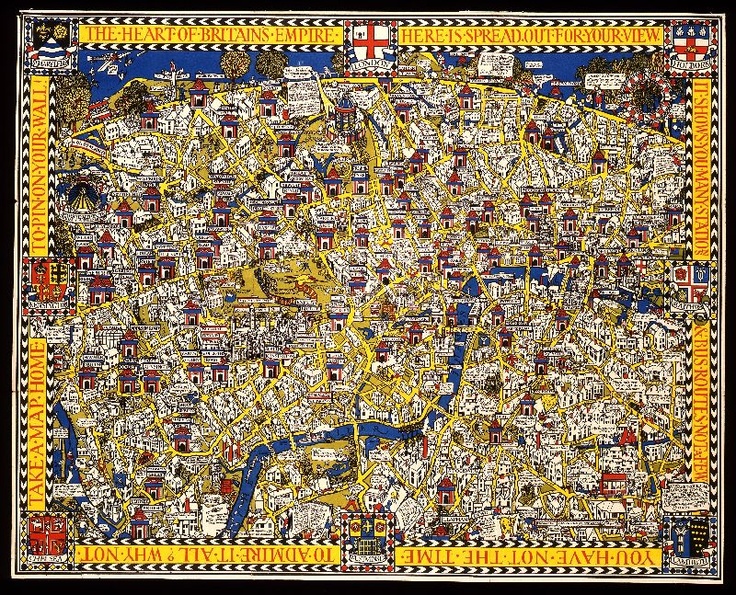
Iconic Map of London's First Underground


Most major world cities now boast far-reaching and convenient subway systems, but London will always have the original from which all the rest descend. It will also, arguably, always have, in the Tube, by far the most iconic. The Metropolitan Railway, the first underground train line to open in London and thus the first in the world, entered service in 1863. Other lines followed, run by several different companies, until all the operators “agreed on a joint marketing strategy in 1908 that featured the now familiar logo with a red disk and the word ‘Underground.'”


But by 1913, writes the BBC’s Emma Jane Kirby, “passengers are moaning about unpunctuality, about overcrowding, about confusion and dirt. The Tube, crammed on workdays (some 400,000 people now work in the heart of the city) is virtually empty at weekends and holidays and the company is fast losing money and public support. What we need, thinks [London Underground commercial director Frank] Pick, is stronger branding.” In addition to the immortal logo, he wanted “some eye-catching posters, distinct from general advertisement bills, that will make Londoners of all social classes proud to journey around their city and visit its attractions.”

But a transit system, even the formidable London Underground, is only as good as its maps. Eric Gill, the Arts and Crafts movement luminary who helped design the Tube’s typeface, asked his architect-cartographer-graphic designer brother MacDonald to come up with an eye-catching one. In the result, writes the Antiquarian Booksellers’ Association of America’s Elisabeth Burdon, “all the attractions and amenities of London are laid before the viewer in a manner which is both visually exciting and yet within a comprehensible structure; the city is presented in the manner of a medieval walled town, the curved horizon recalling the medieval world map’s enclosing circle, all bounded by a decorative border in which coats of arms evoke a sense of stability and tradition.”


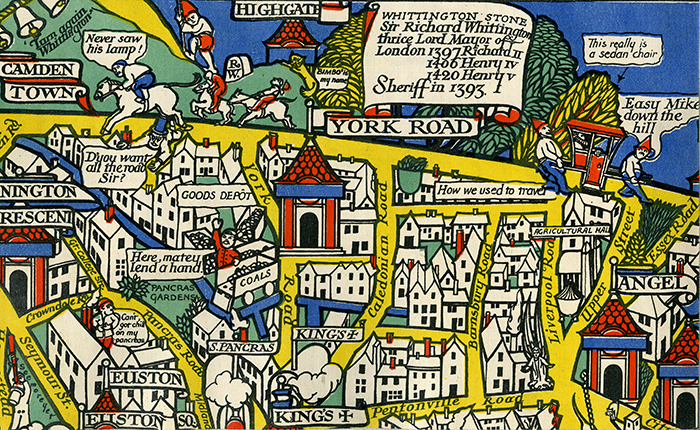
Apart from its degree of historical astuteness and cartographical soundness, Gill’s “Wonderground Map,” as Londoners came to call it, contained enough humor that some of the passengers who consulted it missed their trains due to sheer amusement. Kirby points out that, “on the Harrow Road, a farm worker tilling the soil cries ‘Harrowing work, this!’ an exclamation which is countered by the query ‘What is work, is it a herb?’ delivered by an effete gentleman nearby.” A sign placed at the map’s eastern edge points the way to “Victoria Park, Wanstead Flats, Harwich, Russia and other villages,” while “at Regent’s Park Zoo a prehistoric-looking bird eats a child through the bars of its cage as the child laments, ‘and I promised mother I’d be home for tea by five!'”


The Wonderground Map attained such popularity that it became the first London Underground poster sold commercially for homes and offices, and remains on sale more than a century later. You can view the whole thing online, and in zoomable detail, here; if you’d like a printable version, you can find one here. The history of London now credits it as having effectively “saved” the Tube, whose reputation for dysfunction and discomfort had reached a critical point. Newer subway systems elsewhere may have since made great technological leaps beyond the London Underground but we can safely say that none will ever inspire quite so beloved a work of cartography.

An alternative version of the map can be viewed and downloaded at the David Rumsey Map Collection.

Quoted from original article here.

Thursday, September 8, 2016